

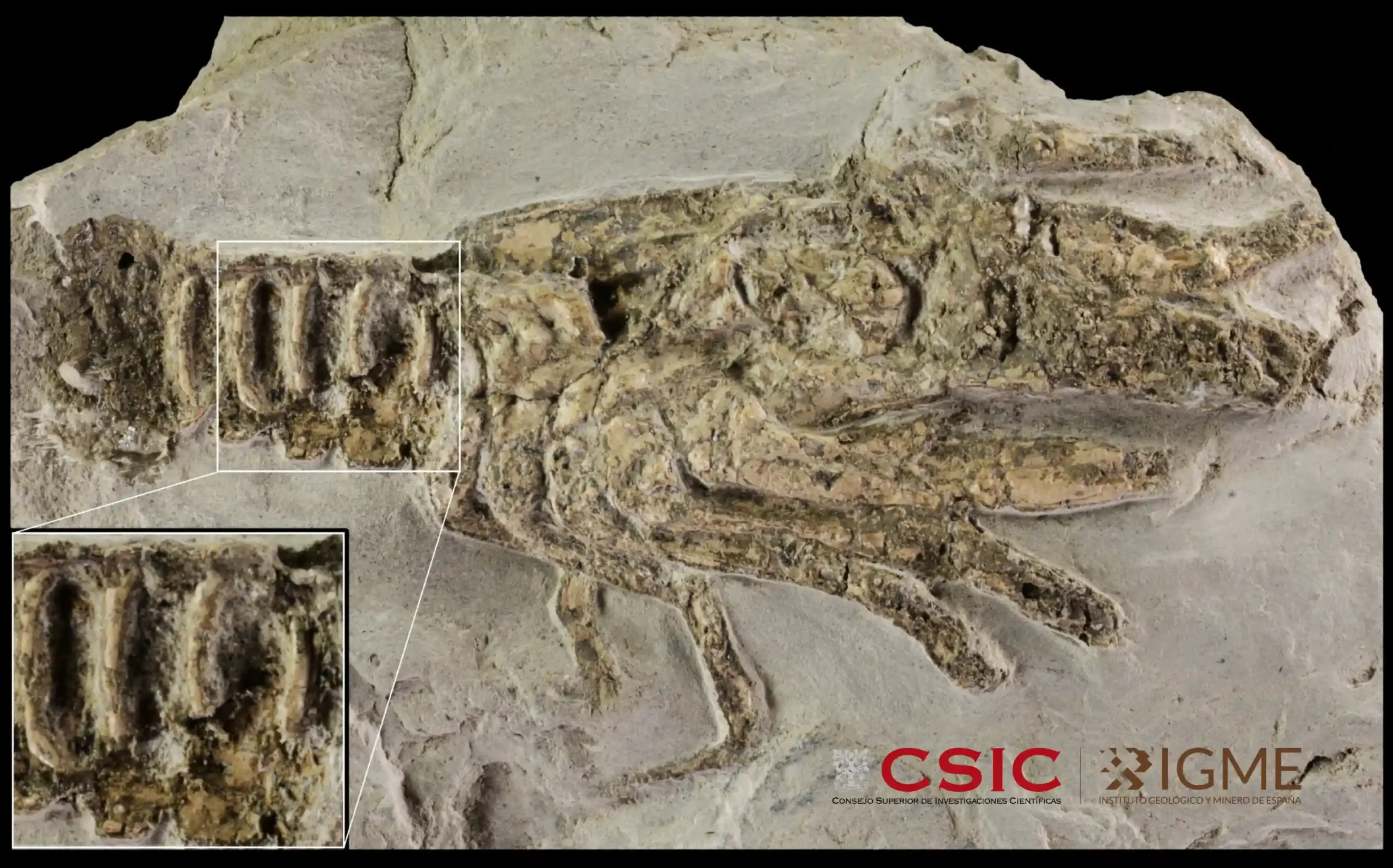
Scientists from IGME-CSIC have discovered a new species of fossilised marine lobster that lived 100 million years ago at La Dehesa mine, located in the municipality of Estercuel, in the province of Teruel. This scientifically significant discovery has led to the identification of a previously unknown species, named Linuparus dehesaensis after the palaeontological site where it was found. Researchers from the University of Zaragoza also took part in the study.
The discovery is particularly remarkable for the exceptional state of preservation of the specimens, which has enabled researchers to identify and examine anatomical features rarely preserved in such detail, including the eyes and antennae.
The fossils were uncovered during clay extraction operations at La Dehesa mine, operated by Euroarce (Grupo Samca). Their discovery in geological layers above the clay deposit being mined has provided access to remains that would otherwise have remained hidden. Euroarce’s collaboration has supported the researchers’ work and facilitated the studies that led to the identification of this new species.
This discovery forms part of Euroarce’s ongoing collaboration with scientific institutions to research and document the palaeontological heritage found at its mining sites in Teruel. One of the most significant initiatives is an agreement with the Geological and Mining Institute of Spain, part of the Spanish National Research Council (IGME-CSIC). Under this agreement, Euroarce facilitates site visits and fieldwork by scientific teams, enabling the systematic study of fossil remains uncovered during mining operations.
La Dehesa clay mine has become a particularly valuable site for palaeontological research. In recent years, it has yielded a wide range of discoveries, including carnivorous dinosaur teeth, fossilised plant remains, amber or fossil resin, and a turtle. The newly identified marine lobster species adds to this growing collection of finds, further establishing the mine as a site of particular interest to the scientific community.
Euroarce and other Grupo Samca companies in Teruel have also been involved in palaeontological research since 2010 through their collaboration with the Fundación Conjunto Paleontológico de Teruel-Dinópolis. Many of the discoveries made through this partnership have taken place at Euroarce’s clay mining sites. One particularly notable example is Mina Beatriz, in Oliete, where extraction work revealed dinosaur footprints preserved in soft sediments, an exceptional find. These fossils are now on display at the Aragonese Museum of Palaeontology.
Work carried out at Grupo Samca’s mining sites has led to the discovery and cataloguing of fossils belonging to a remarkable diversity of organisms that inhabited the province of Teruel at different stages of its geological history. These include remains of turtles, crocodiles, dinosaurs, bivalves, gastropods and fish, among others. Such discoveries help expand scientific knowledge of how species and ecosystems evolved over time, while highlighting the research value of the geological formations found at mining sites across Teruel.
The relationship between mining and palaeontological research demonstrates that the two activities can complement one another and deliver valuable benefits to society. Mining operations provide access to geological layers that would otherwise remain hidden beneath the surface, some of which contain fossils of considerable scientific importance. Careful monitoring during extraction, prompt reporting of discoveries and close collaboration with specialist research teams make it possible to identify, recover, study and preserve these valuable remains.
The partnerships with institutions such as IGME-CSIC and the Dinópolis Foundation reflect Euroarce and Grupo Samca’s commitment to scientific research and to preserving and promoting the palaeontological heritage of the province of Teruel.