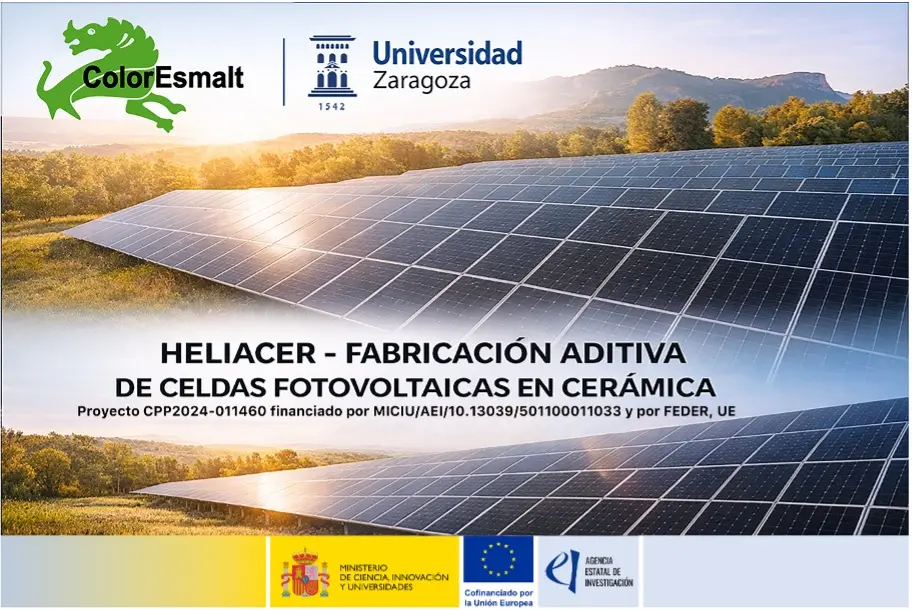

ADDITIVE MANUFACTURING OF PHOTOVOLTAIC CELLS ON CERAMIC (HELIACER)
The research project Additive Manufacturing of Photovoltaic Cells on Ceramic (HELIACER) develops low-cost building-integrated photovoltaic (BIPV) cells through an innovative monolithic process based on the direct printing of inks onto ceramic substrates.
The project uses fully inorganic perovskites, which stands out for its superior long-term and thermal stability compared to hybrid perovskites, thereby ensuring greater durability of the final product. Although this approach is not primarily aimed at achieveing the highest solar conversion efficiency per unit area, it is designed to maximise net daily energy production across large surfaces on façades and architectural elements.
The HELIACER research project represents a natural evolutionary step, building on the knowledge generated in the BONIFACE research project to develop a more integrated and scalable process through the direct printing of all functional layers.
A distinctive feature of the project is the alignment between academic research and industrial implementation. Scientists from the University of Zaragoza, experts in perovskites for photovoltaic applications, will use the same digital inkjet ink printing technology as Color Esmalt, replicating industrial processes at laboratory scale.
This strategy ensures direct and efficient knowledge transfer, accelerating process optimisation and facilitating industrial scale-up. The use of similar equipment in both environments allows immediate translation of laboratory advances to the production line.
This project aligns with the Strategic Energy Technology Plan (SET Plan), the EU’s key instrument to accelerate the transition towards clean, secure and competitive energy through collaboration in research, development and innovation.
The proposal is also aligned with the Sustainable Development Goals, specifically Goal 7: “Affordable and Clean Energy”, and with Spain’s Recovery, Transformation and Resilience Plan (PRTR), funded by the Next Generation EU funds under the cross-cutting axis of the ecological transition. HELIACER directly impacts one of the country’s most important productive sectors — ceramic manufacturing — which therefore has significant capacity to transform Spain’s economic and social fabric.
This project is funded by the Spanish State Research Agency under the 2024 Public–Private Collaboration Programme within the framework of the State Plan for Scientific, Technical and Innovation Research 2024–2027.